
An Introduction to Marketing & Communications
Estimated time: 10 minutes
Learning objectives
By the end of this lesson you’ll be able to:
Understand the structure of an effective marketing and communications strategy
Apply this understanding of a marketing and communications strategy structure to your own business
1. Introduction
So far in this module we’ve established:
Effective marketing and communications should shape perception and relationships, not simply generate awareness
The relationship that you build with audiences through marketing and communications is what guides them from awareness to action
Audiences are irrational actors with unprecedented access to information. They are well informed, unpredictable, and often act on instinct
Creating a strategy is the means by which these factors can be controlled and mitigated. Without a strategic approach, marketing and communications activity becomes fragmented. Over time, this fragmentation makes it harder for audiences to understand what the business stands for or why they should choose it.
With the reasoning in favour of adopting a strategic marketing and communications approach established, this final lesson in the opening module addresses the question: what does a marketing and communications strategy consist of?
2. How it works
At its core, a marketing and communications strategy is a series of foundational decisions - objectives, audiences, tone of voice, messaging, channels, etc - that informs day-to-day marketing activity.
In all likelihood, through the process of establishing and running your business, you’ve already made most of the foundational decisions that underpin a strategy.
Therefore, when asked “What does a marketing and communications strategy consist of for your business?” The mos probable answer is a formalised and optimised version of what you are already doing.
This is the role that a strategy plays. So, when planning your strategy, we need to establish what you and your business needs from it. This can be broken down into four broad categories:
Reduce Decision Fatigue
A marketing and communications strategy establishes which decisions are fixed and which are variable. There’s ample evidence to show that making decisions reduces one’s ability to make subsequent decisions. This means that careful consideration should be given to the type of decisions that you are prioritising. Some business leaders have taken this to the extreme, such as Steve Jobs who famously wore the same, or a variation of the same, outfit every day. Part of this is of course branding, but it’s also to remove less important decisions so that attention and energy can be spent on those that are business critical. This is not to suggest that you should adopt a similar approach. However, it’s worth considering which decisions deserve your time and attention, which to delegate, and which to deprioritise.
Institutionalisation of Approach
A marketing strategy that’s in your head rather than on paper can be made to work if your business has a low head count – although it’s still not optimal. As your business grows the likelihood that staff apply their own interpretation to marketing increases. A strategy ensures that each member of staff has a clear understanding of the businesses’ marketing approach, reducing the likelihood of deviation and creating a consistent tone and brand.
Increased Consistency
With marketing decisions made and institutionalised across the company, execution then becomes a matter of applying those decisions, rather than having to re-determine them each time a campaign is designed or social post drafted.
Optimisation
A fully operational marketing and communications strategy will create a range of data points - social media engagement, website visits, sales, etc. These data points can be used to evaluate the effectiveness of your marketing efforts which in turn gives the information necessary to make improvements.
3. Example
Sticking with the café example used throughout this module. Imagine yourself as the owner of the café. You have just hired a new member of staff and are in the process of setting their responsibilities. One of the responsibilities that you decide to partially delegate is handling the café’s marketing.
There are two scenarios. One where you on-board the new hire without a defined strategy. This would likely leave you scrambling to explain the café’s marketing approach and leave a lot to interpretation. Instructions would be vague and situational: “Post when it feels right.”, “Usually we do this…”. Without a strategy in place your café’s marketing would become driven by habits and instinct with the justification for why, what, and when you communicate being dictated by circumstance rather than a thought through rationale – for example scheduling posts on socials at a certain time of the day because it’s what you’ve always done rather than it being the opportune time for engagement.
The other scenario is where you on-board the new hire using a clearly established strategy where key decisions have already been made and are clearly signposted. As the café’s owner you can outline who the café is for, how it wants to present itself, why customers should choose it, and what the communication priorities are. Having already made these decisions, and clearly illustrated them, you’re providing the new hire with a map that they can use to deliver what you ask of them. As with anything, the more preparation done, the clearer the instructions given, the more likely you are to find success.
4. Marketing & Communications Strategy Structure (Overview)
With the theory established, it’s time to look at what’s included in each section of the marketing and communications strategy. At Notus we use the FRAME process for structuring marketing and communications strategies. FRAME assists with the creation of comprehensive strategies that are firmly grounded in the audience awareness journey.
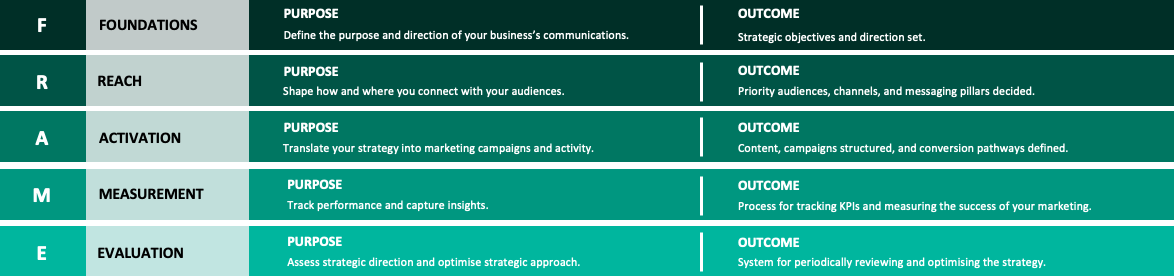
In the coming modules we’ll go into detail on each section of the FRAME process and walk through the steps necessary for completing each so that you are equipped with the knowledge to draft your own strategy.
5. Parting Thought
Most marketing and communications problems do not stem from a lack of effort, creativity, or tools. They stem from decisions being made out of sequence. A clear structure does not guarantee success, but it makes consistent, intentional progress possible.
The next module, Discovery, is where you’ll do the necessary research and analysis of your business’s market, audiences, competitors, and internal operations to determine the optimal shape of its marketing and communications strategy.