
An Introduction to Marketing & Communications
Estimated time: 10 minutes
Learning objectives
By the end of this lesson you’ll be able to:
Explain how what the audience awareness journey is and how it’s relevant to the relationship your business has with it’s customers and partners
1. Introduction
In the previous lesson we explored how marketing and communications are tools used for shaping perception and managing relationships with customers, partners, and the media – in other words, your stakeholders. If marketing and communications are tools for shaping perceptions, then the products they create are touchpoints. As was also briefly touched upon in the previous lesson, touchpoints are the cues that inform the decision-making process before a purchase is made.
In this lesson, we’ll look at how touchpoints are used to move stakeholders from being aware of a business to shortlisting it, choosing it, purchasing from (or partnering with/promoting) it, and ideally becoming a loyal customer or frequent collaborator. This process is known as the Audience Awareness Journey.
2. How it works
Before drafting your own Marketing & Communications Strategy it’s crucial to gain an understanding of the Audience Awareness Journey. A Marketing & Communications Strategy is essentially a map that charts how stakeholders progress through the Audience Awareness Journey.
The Audience Awareness Journey was traditionally taught as a linear process - often depicted as a funnel. In the funnel model, audiences start with a wide range of options and then marketing progresses them through the funnel, as they progress they gradually eliminates options, until finally making a choice.
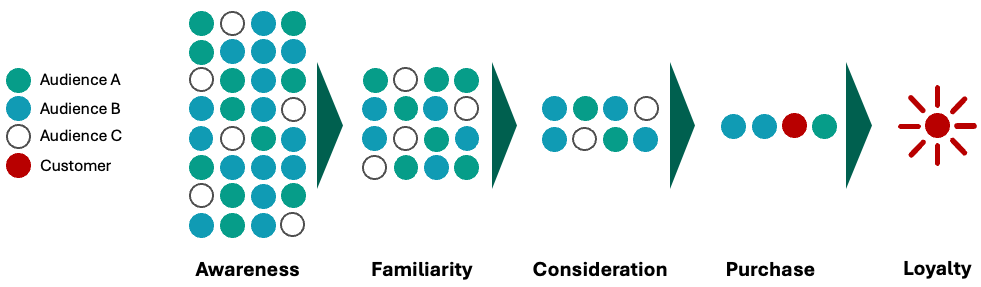
While conceptually simple and therefore easy to understand, the funnel model was theorised during a time when audiences were exposed to a limited number of touchpoints. This was manageable for businesses when a select few tv stations, radio stations, and magazines dominated nationally and there were still very healthy localised media scenes. However, in the past 20 years the growth of mass communications and the globalisation of logistics have changed the reality of advertising and doing business for most companies. The funnel model is therefore out of date as it fails to capture all the touchpoints and buying factors resulting from the saturation of products, the influence of new forms of media, increased customer awareness, and a more competitive market.
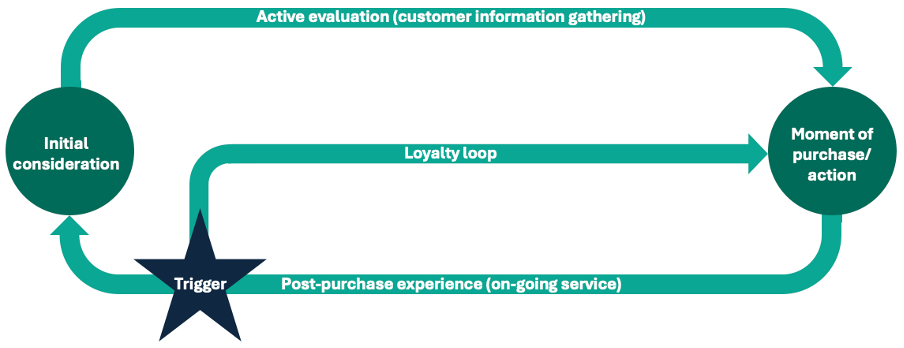
With this changed landscape in mind, the Audience Awareness Journey is better understood as a series of loops rather than a straight line. Before the audience acts (purchases, partners, or promotes), these loops centre around gathering the information and reassurance necessary to commit. After acting, the loop shifts to evaluating whether the choice was worthwhile. That post-action experience (how well the product performs, how the brand behaves, how easy the service is to use, etc) determines whether an audience repeats their business, recommends you to their friends or network, or decides to consider alternative options when making their next purchase or partnership.
David Ogilvy (founder of advertising agency Ogilvy & Mather and the “Father of Advertising”) captured the essence of when he wrote, “The consumer isn’t a moron; she’s your wife.” The phrasing may show its age, but the sentiment is more relevant than ever: respect your audience’s intelligence and recognise that you’re in a relationship with them.
Modern consumers have unprecedented access to information. Ingredients, manufacturing processes, the way you treat your staff, reviews, pricing comparisons - very little is hidden. Your business is being continually evaluated, whether you are aware of it or not. When you recognise the audience journey as being a fragmented, perpetual, and experience-driven process, your communications can support it rather than rely on the assumption that your stakeholders will act rationally.
3. Example
Throughout this course we’ll continue to use the café analogy from the previous lesson. Hospitality venues are useful examples for a number of reasons. Firstly, even if your business is completely unrelated to hospitality, chances are you have a decent understanding of how the industry works even if only on a surface level. Secondly, the touchpoints mentioned in the previous lesson are easily visible in hospitality - if you walk into a restaurant and the floor is filthy you’ll soon decide if it’s somewhere you’d like to eat. Identifying touchpoints for other industries can be more difficult, especially those that aren’t face-to-face. To help with this you’ll have received a variety of completed example strategies in your welcome email.
On to the example - In the previous lesson we explored how a series of touchpoints (Google Map reviews, the interior, customers seated close to the window) brought you to the door of the last café you visited. At this stage in the audience journey you’ve progressed through the initial consideration phase and are in the process of active evaluation approaching your moment of action. From the point of opening the café’s door to approaching the counter and ordering you’re still under the influence of touchpoints – the price of the coffee, how clean the café is, what free seating is available.
Once you purchase a cup of coffee, the dynamics influencing your decision-making change. You are now no longer relying on external indicators or expectations, instead you can form your own judgements based on direct experience. At this stage, several behavioural heuristics come into play that will ultimately determine whether the café becomes a preferred option or whether you choose an alternative next time.
Confirmation bias: Did the coffee, service, and atmosphere meet your prior built expectations? If it met excpectations you’ll be vindicated in your assessment and more likely to return
Loss aversion: Did any aspect of the experience feel underwhelming? Did it feel like either time or money had been wasted? If so, this will have a disproportional impact the next time you choose a café
Ease of use: Was the overall process was smooth? If so, returning in the future will feel low-effort
Moving a potential customer from evaluation to action is the hardest part of the audience journey as persuading a customer to make a first purchase is cognitively demanding. Prior to that moment they make a decision, they are managing a lot of uncertainty: uncertainty about quality, about value, about how the experience will compare to alternatives. Once the first purchase is made, that uncertainty is replaced with evidence. A positive post-purchase experience reduces both perceived risk and cognitive load. As a result, securing a second purchase typically requires far fewer inputs – or touchpoints. The customer’s decision-making process becomes shorter, more intuitive, and more heavily influenced by habit formation. In behavioural terms, the customer’s reference point shifts as they stop viewing the café as an unknown risk and instead judge it on the value it’s proven.
To put things simply, it’s easier and cheaper to keep an existing customer happy that it is to win a new customer.
4. Parting Thought
Very few businesses can succeed if they focus solely on attracting first-time customers without considering the full extent of the audience awareness journey. The businesses that are able to succeed without placing their focus on the Audience Awareness Journey either have a captive market or their margin is made on underdelivering to a high churn of customers. In this lesson we have learned that for the vast majority of companies that do care about their customers and partners, it’s necessary to help guide them through the stages of the audience awareness journey, guided by touchpoints, towards the moment of action and loyalty.
You’ll shortly begin to draft your own strategy. When doing so return to the concepts taught in this lesson and be conscious of how the decisions you make while drafting your strategy will impact your stakeholders’ progression through the Audience Awareness Journey.
In the next lesson, the last of the introductory module, we’ll take an in-depth look at how your Marketing & Communications Strategy should be structured.